
大-905x500.jpeg)
大.jpeg)
万里不挑一 Vol.4:陈量
Unparalleled collection Vol.4 : Chen Liang
展期:2025年01月10日—03月24日
艺术家:陈量
地点:万一空间|深圳市南山区海上世界文化艺术中心2层202
陈量个展聚焦禅宗与民间艺术,展出艺术书写、学术研究书目及民俗物件。
Chen Liang’s solo exhibition focuses on Zen and folk art, featuring artistic writings, academic research bibliographies, and folk objects.
万一空间欣然于2025年首展呈现“万里不挑一”系列企划的第四期,并荣幸邀请艺术家陈量作为本期主展人。
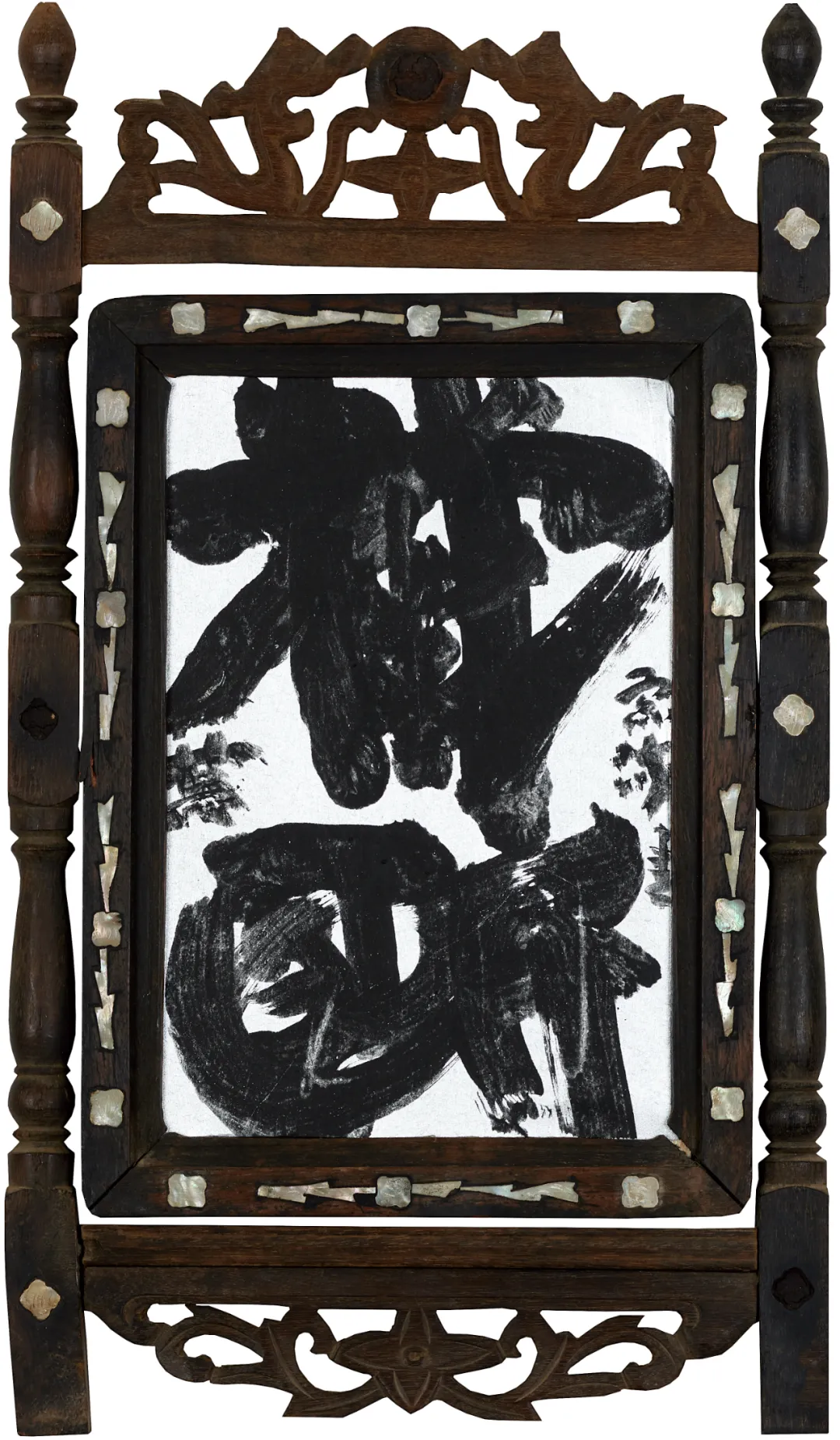
《渡庐集》其一 One of the Duluji collection
截断 Jieduan
陈量 Chen Liang
老框、宣纸、墨 Old frame, rice paper, ink
尺寸可变 Size variable
2018-2024
©艺术家及其工作室 Image courtesy of the artist and artist‘s studio
此次展览聚焦于陈量作为艺术家十余年的研究撷英以及他对禅宗与民间艺术的收集与梳理。展厅内将展出艺术家以虚堂智愚、寒山、拾得等高僧的诗偈为主题,以禅宗与民艺思想的交融互动为媒介的一系列艺术书写作品、学术研究书目,以及他在田野调研中从各地收集而来的民俗物件。这些物品、书籍和创作共同构成了他在研究与创作中所依据的知识框架。同时,展厅将作为“神圣空间”与民俗集成叠合的意象载体,邀请观者跟随艺术家的社会学研究路径,从“照壁”、“庙会”与“禅窟”三个展区逐步探索规整有度的文字的内意表达与溯源、观摩民俗语境下的自然主义创作,并试图从人类学理论中理解,如何将这些“背离”于主流文化的视觉产物置于一种特定的社会情境里。

集物之趣上,陈量认为“我藏民艺,不嗜老旧,唯在触动。”对于民间艺术品收藏,他并非出于娱乐化或猎奇化民俗的心态,而是切身实地进行田野考察、梳理与研究民俗中的体系和逻辑,旨在呈现民俗的智慧体系。其一,民艺的偶发状态。从镌刻于木石表面上的痕迹,可以看出手工艺人在学习雕刻中的一种从“不会”走向“会”的探索过程。物品作为见证者,保留了一个人在最自然和无意识状态下的“不会的历史”,是一种在艺术家看来无相观下的完美。其二,民艺在非展览时代的空间运用。在最重要的节日里,观者远离当下的白盒子展示空间,转而贴近民众自发搭建并聚集的“展览现场”。社火、庙会、摩崖作为宗教仪式与民众创作的载体,以地方性的民俗仪式呈现出各类游艺活动。这些仪式与当地神话传说紧密结合,从一系列唱词、面具、舞蹈等行为中逐步创建一种赫胥黎称之为“仪式化”的沟通行为,而这一临时的仪式世界又由一场纯想象力表演中的演员与观众共同构建。

海报设计:
周嘉
Chen Liang
As a field that bridges the past and the present of the complex art forms, W.ONESPACE provides a unique platform and invites art practitioners in different areas, jointly present an image containing unique personalities, aesthetic interests of multi-perspective. Exhibited works and collections in the project have no priority, nor distinction. We expect the project to give the audience a realistic understanding of how the artists’ habits influence their works, and how they relate to artists’ lives. Through a “real-life” scenario, we can put aside redundant interpretations of any art form, just offering an angle that could be perceived to see the story behind.
This exhibition focuses on Chen Liang’s research and his collection and study of Zen Buddhism and folk art over more than a decade of his artistic practice. The exhibition will showcase a series of artworks inspired by Zen monks’ gathas, works that use daily Zen practices as a medium for artistic expression, academic research bibliographies, and folk objects collected during field research from various regions. These objects, books, and artworks together form the knowledge framework on which Chen Liang’s research and creation are based. The exhibition space will function as a “sacred space”, integrating the imagery of folk traditions, inviting viewers to follow the artist’s sociological research path through three distinct sections: “Zhaobi” (Screen Wall), “Temple Fair,” and “Meditatiion Cave”. This progressive exploration will delve into the nuanced expression of structured writing, the origins of meaning, the study of naturalistic creations within the context of folk traditions, and an attempt to understand from an anthropological perspective how these visual artifacts, which deviate from mainstream culture, can be placed within specific social contexts.
Indeed, when talking about writing, it is impossible to overlook the artistic form of calligraphy.
Although Chen Liang frequently uses calligraphy as a medium in his creations, he focuses on expanding the “boundaries of writing” as a contemporary issue. He also extends the discussion on what constitutes life-like writing and how to read the nuances of Zen Buddhist texts. During his field research, he explores how folk art practices such as paper cutting, embroidery, ledger writing, and ceramic inscriptions—activities not primarily involving the brush—can convey information, the process of writing, and the results of these creative acts. When the writing of poetry and prose does not conform to the “traditional rules”, it transforms into a form of automatic writing and fragmented communication. In this case, technique becomes extraneous, even a constraint, and writing and drawing become liberated. The body becomes the carrier of spiritual writing, while tattoos and totems etched on the body serve as the most direct forms of expression in human primitive experience. Additionally, Chen Liang’s understanding of Zen Buddhism is not merely concerned with the current superficial interpretations of “empty Zen”, but focuses on Zen practice as it merges into daily life—Zen is present everywhere, and the boundaries between the secular and the elegant dialectically exist. This understanding naturally emerges from his collection of woodblock prints of Zen monks image by Shiko Munakata(1903-1975).
In terms of his collection of folk art, Chen Liang says, “I collect folk art not for the sake of antiquities, but because I am moved by it.” His collection of folk artworks is not motivated by a desire to entertain or to indulge in the exoticism of folk customs. Rather, he engages in fieldwork, sorting, and studying the systems and logic embedded in folk traditions. His goal is to present the wisdom inherent in these customs. Firstly, he sees the spontaneous nature of folk art as significant. The traces carved on wood and stone surfaces reveal the craftsman’s process of moving from “inability” to “ability” in their learning of carving. Objects, as witnesses, preserve the “history of inability” of a person in their most natural and unconscious state, which, from the artist’s perspective, reflects a perfect state without form. Secondly, folk art’s use in non-exhibition spaces is significant. During major festivals, the audience steps away from the contemporary white-box gallery spaces and instead engages with the “exhibition” created spontaneously by the public—such as the processions, temple fairs, and cliff grarvings sutruas and figures that serve as carriers for religious rituals and community creativity. These folk rituals are closely tied to local myths and legends, and through performances such as songs, masks, and dances, they create a “ritualized” communication process, as described by Aldous Huxley. This temporary ritual world is jointly constructed by the actors and audience in an imaginative performance.
During his fieldwork, Chen Liang adopts an approach he describes as “working like a farmer in the fields”. This method has become his unique working methodology as an artist, scholar, and teacher. He seeks to work in the field in a way that is close to the original form of writing. In this process, the boundaries between words, images, and meanings become increasingly blurred. By deeply integrating into the local cultural context, he transforms and harmonizes into a form of self-writing that leads to enlightenment. Through this practice, he constructs a personal path of self-cultivation rooted in folk art and Zen Buddhist practice.
陈量
Chen Liang


©万一空间 Copyright©W.ONESPACE

“万里不挑一”为万一空间推出的系列特别企划,每期将邀请不同角色的艺术从业人士,为观众带来自己的艺术作品以及横跨多学科的收藏。该项目旨在通过万一空间这一弥合古今和多元艺术形态的特殊平台,使主展人在展厅内还原一个艺术与生活的平衡点,以此让观者真情实感地理解收藏如何与生活融合。借由一个“真实发生”的场景,抛开对艺术种类的冗余界定,以一个能够亲身感知的角度,去体味艺术背后的故事与丰富的意识世界。


