

中国艺术家群展:虚实生新
Reality and Illusion: A New Genesis
展期:2025年05月16日—07月12日
开幕:2025年05月16日 15:00
艺术家:陈彧凡、高入云、倪志琪、钱佳华、王小松、张汲、朱金石
地点:艺术门|上海市黄浦区香港路117号2楼203室
本次展览聚焦“虚实”哲学概念,呈现七位艺术家作品。“虚实”非简单对立,艺术家以独特语言探索物质与精神等关系,作品挑战传统认知,激发新艺术语言和观念形态。This group exhibition focuses on the concept of reality and illusion. Featuring works by seven artists, it explores the complex relationships between substance and spirit. The artworks not only challenge traditional concepts but also stimulate new artistic languages and conceptual forms in the interplay of reality and illusion.
在这个展览中,“虚实”并非简单的二元对立,而是一个相互渗透、相互生成的动态过程。艺术家们以各自独特的艺术语言,在“虚”与“实”之间寻找平衡点,探索着物质与精神、现实与想象、形式与观念之间复杂而微妙的关系,不断拓宽艺术的边界。这些作品不仅对传统认知发起挑战,更在虚实交错中激发了新的艺术语言和观念形态。
Shanghai—Pearl Lam is pleased to present Reality and Illusion: A New Genesis, a group exhibition focusing on the philosophical concept of reality and illusion with works by seven artists, including Chen Yufan, Gao Ruyun, Ni Zhiqi, Qian Jiahua, Wang Xiaosong, Zhang Ji, and Zhu Jinshi. As an important topic explored by artists since ancient times, reality and illusion has been expanded to concepts, emotions, media and other levels in the context of contemporary art, which will be highlighted in this exhibition.
Reality and illusion are not merely simple binary opposites, but rather they represent a dynamic process of interpenetration and mutual generation. Artists strive to find a balance between reality and illusion, exploring the complex and subtle relationships between substance and spirit, reality and imagination, as well as form and concept while utilising their unique artistic languages to broaden the boundary of art. These artworks not only challenge traditional concepts but also stimulate new artistic languages and conceptual forms in the interplay of reality and illusion.

Derivatives – Remaining Scenery No. 7
衍⽣物-剩余的⻛景之七, 2023
Acrylic on canvas 布⾯丙烯
65.5 x 45 cm (25 3/4 x 17 3/4 in.)
Chen Yufan takes his inspiration from Daoism and Zen Buddhism. He turns Daoist and Zen Buddhist philosophies into a personal interpretation and meditation through a repetitive process of employing dots, regular lines, and pure colours. Chen’s work revolves around the optical structure and the force of intent; his unique artistic expression is grounded in both the assembly and scattering of objects and space. Through surfaces composed of dots and lines as well as spaces constructed by surfaces and objects, a trace of time is unleashed when these elements overlay upon one another. The dialogue between the artist and his mediums becomes a significant subject, resembling that of an internal meditation and is a form of performance art rooted in concepts. Among these works on show, one can see the unique perception of time and space, which present a kind of beauty that transcends reality, offering both a reimagining of the world and an intimate reflection of the artist’s inner self.
LOOP LOOP f, 2024
Carbon fiber printing, acrylic plate, copper plate, motor
碳纤维打印、亚克力板、铜板、电机
H24 x W22 x D10 cm (H9 3/8 x W8 5/8 x D3 7/8 in.)
In his installation works, Gao Ruyun uses mechanical movement with no intended form or rhythm to avoid subjectivity or emotion. This constant cyclical movement leaves the viewer’s consciousness to follow the geometric trajectory of the lines and to linger in an undefined time and space constructed by the works. This show highlights small installations from Gao’s LOOP series, which continue his exploration of line movement and temporality that began in 2011. The artist constructs different spatial structures by connecting ropes, fishing lines, and acrylic materials; he subtly integrates the movement and rhythm of lines into them, blending representations of the tangible world with inner imagination. The dialogue between reality and illusion not only showcases Gao’s profound understanding and mastery of materiality but also reflects his contemplation on the passage of time and the transience of life.
World Theatre 世界剧场 (detail 局部), 2025
Gauze, thick handmade paper, oil and acrylic
纱布厚手工纸油彩丙烯
240 x 640 cm (94 1/2 x 252 in.)
60 x 80 cm x 32 (23 5/8 x 31 1/2 in. x 32)
This exhibition features Ni Zhiji’s World Theatre, a comprehensive material painting composed of 32 monochrome square colour blocks pieced together, inspired by the artist’s observation and refinement of daily life. The artist pays particular attention to the colour and texture of his materials; their visual impact and characteristics maintain a subtle dialectical relationship in his creation process. By layering colours, materials, and textures, time and memory are sealed within Ni’s works. With the help of Chinese traditional techniques, the artist’s gentleness and warmth are slowly revealed. The core concept hidden in the faded colours and rough edges of his works is a philosophical outlook on time and memories from an Asian perspective. Through the recording and reconstruction of time and memory, the complex relationship of reality and illusion is shown, which is not only a reflection of the real world but also a deep excavation of the inner world.
Pack 打包, 2025
Wood, linen, acrylic, oil paint, lacquer, etc.
木、亚麻布、丙烯、油彩、漆等
74 x 53 x 12.5 cm (29 1/8 x 20 7/8 x 4 7/8 in.)
Qian Jiahua’s paintings emphasise the flat perspective of the picture. The colours, lines, and blocks in her works support each other, presenting an architectural accuracy and rhythm. The artist improvises while painting, embracing unexpected contingencies. The layers in her paintings intertwine spontaneity, interaction, and balance. Due to the shortage of supplies, in 2022, Qian explored removing the canvas from an old painting and stretching it back into the frame; the picture texture and the physical creases formed by the boundary of the frame after the cloth surface moved became the new painting interface. In the works of this exhibition, we can see that the artist conveys the sensitivity of nerve endings in the game of reality and illusion, while balancing aesthetics.
Potentiality 潜能, 2022
Mixed media 综合材料
156 x 158 x 10 cm (61 3/8 x 62 1/4 x 3 7/8 in.)
Wang Xiaosong’s works feature “multi-dimensional painting”. By breaking the plane restrictions of traditional painting, he creates a multi-dimensional space with a sense of depth and hierarchy, exploring curved and wrinkled space. Wang extends the line, colour, composition, texture, and other variables in plane painting to multi-dimensional space. He uses the relationship between monochrome and convex pictures in a large, curved area to explore the connection between forms and variables in curved space. Wang always adheres to the traditional “oil paint and canvas surface” as the main medium and form. He breaks through the visual definition of the inherent rectangular outer frame or other geometric boundaries in traditional painting, creating a real and illusory visual experience.

The Skin of Truth 20236
真理之皮20236, 2023
Oil on canvas 布面油画
97 x 101 cm (38 1/4 x 39 3/4 in.)
Zhang Ji’s art creation focuses on taking motifs from ancient religious architecture and referencing them through abstract painting. He replaces traditional brushstrokes with paint reliefs painstakingly created with a custom-made industrial pneumatic injector. The artist uses a language that opposes painting in a manner akin to physical experimentation and distils a form of painting that defies conventional notions of the art form. Zhang uses a large amount of oil paint and special pneumatic syringes to create a bas-relief weight on the canvas. In the whole strict creation process, the artist upholds a religious practice like that of an ascetic monk and completes the spiritual meditation channeled through his body and reflected in his art. Through the unique treatment of religious symbols and images, his work discusses the relationship between the material and the spiritual as well as reality and illusion.

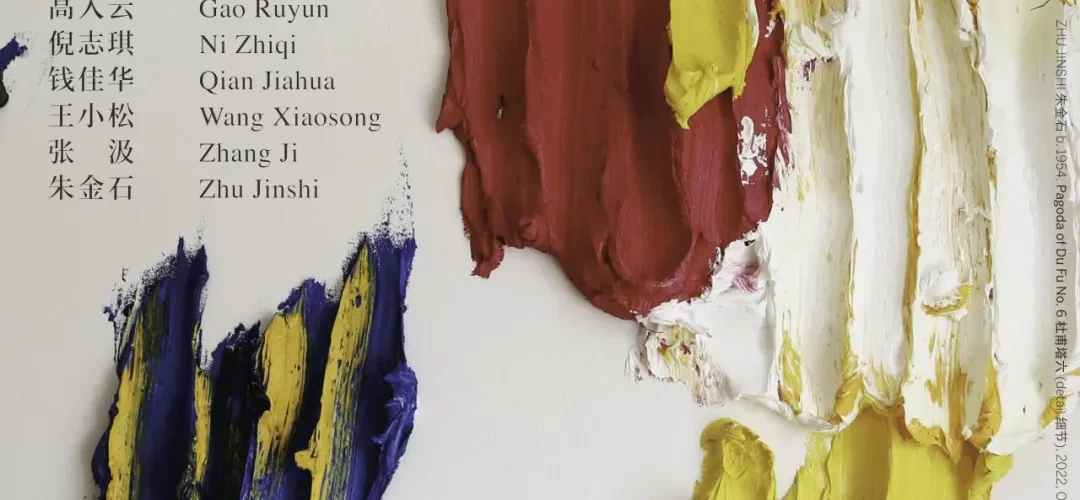
Pagoda of Du Fu No. 6 杜甫塔六, 2022
Oil on canvas 布面油画
180 x 160 cm (70 7/8 x 63 in.)
Looking back at Zhu Jinshi’s art practice over the past forty years, abstract painting and conceptual installation are two practices that parallel each other while sometimes being confrontational. Zhu’s colourful “impasto” painting is unique, presenting a highly sculptural three-dimensional visual experience. His installation Rice Paper Pagoda was featured in the 60th Venice Biennale’s China Pavilion. It is a giant pagoda shaped work made of thousands of pieces of paper, cotton thread, bamboo poles, and so on. In the work, the physical characteristics and cultural attributes are dissolved, and lightly stacked rice paper is transformed into something complex and tough, creating a virtual scene like floating in time and space for the viewer. This exhibition features Pagoda of Du Fu No. 6, a resonant reflection of Zhu’s signature style.


