

雷娜·裴:skin in my stomach
Lêna Bùi: skin in my stomach
展期:2025年11月13日—2026年01月17日
艺术家:雷娜·裴(Lêna Bùi)
主办:麦勒画廊
地点:麦勒画廊|瑞士苏黎世拉米街
雷娜·裴首次个展,以绢本绘画、摄影、织毯及影像探索材料与自然形态,将身体视为世界镜像,借胃的象征连接内外,呈现触觉与诗意的感官体验。Lêna Bùi’s first solo show explores materials, natural forms via silk paintings, photography, tapestry & moving images, viewing body as world mirror, symbolizing stomach to connect inner-outer worlds with tactile, poetic experiences.المعرض الأول الفردي لـ Lêna Bùi يكتشف المواد والشكل الطبيعي من خلال رسومات الحرير والفوتوغرافيا والسجاد والصور المتحركة، مع النظر إلى الجسد كمرآة للعالم، ويتجسد المعدة كرمز يเชِّل بين العالَمين الداخلي والخارجي، مع تقديم تجارب حسية ملموسة وشعرية.
skin in my stomach是雷娜·裴在麦勒画廊的首次个展。展览精选了艺术家近期创作的质朴而严谨的部分作品,通过绢本绘画、摄影、手工织毯与动态影像等多种媒介,完整呈现了艺术家在材料、自然形态方面的探索,以及她将身体视为世界镜像的这一艺术理念。
基于对人体内部运行机制的了解,并受到生态学家David Abrams将身体视为“变化发生之地”这一概念的启发,雷娜将身体看作“体验世界的直接且唯一途径”,也是“建立或切断联系的场所”。在许多医学传统中,胃部被视为一个强有力的象征——它是滋养、直觉与交流的核心,作为连接我们与外部世界的纽带。艺术家同样将人体视作时间的容器,不断将我们与祖先以及塑造了我们的历史的气候相连。正因如此,胃既是最脆弱的,却也是最富有韧性的器官——它敏锐地感知每一次细微变化,并以高效而优雅的方式调节着身体与外部世界的交流。
这个复杂的构思从画廊的一层延伸至地下一层,由各具特色却又浑然一体的部分构成。走进画廊,观众首先会看到一系列规格与呈现方式各异的丝绸作品——有的悬挂在墙面上,有的则竖立在展厅中央。每件作品透明度各不相同,这源于艺术家对材料的交替运用:丝绸叠层、丝绸覆于摄影作品上,或是丝绸与纸张的结合。丝绸既脆弱又具有吸附性,更难以掌控!总的来说,丝绸通过其纤维进行“呼吸”,对周遭环境产生反应,因此需要创作者具备耐心、技巧和应变能力。

higanbana, 2025
绢本及无酸纸上墨彩|ink and watercolor painting on silk and archival paper
82 × 122 × 6 cm (带框|framed)
雷娜敏锐的目光总能捕捉到自然界的片段——植物的特写、精妙的生命形态,这些令她着迷的景象成为她默然无声的灵感源泉。这些有机的细节通过摄影方式记录后,又经由细腻的笔触融入她的创作。她运用湿绢本绘画技法——这种植根于越南传统工艺的技法将颜料层层渲染于湿润的绢面上,让水彩与墨色自然流淌、交融并逐渐显现。这种创作方式赋予画面通透空灵的质感,映照着空气的透明度、湿度的氤氲,以及生命中那些转瞬即逝的片刻。
在丝绸上创作如同探索层层叠叠的秘密:鲜亮的色彩既能遮蔽也能凸显底层画面,而深沉的色调反而让底色若隐若现,这种视觉反转恰似感知本身的复杂性。在这个过程中,她的创作方式与摄影曝光时的诗意舞蹈呼应——既是揭示也是隐藏,捕捉着具有景深层次的画面,引人沉思生命本身那转瞬即逝、难以捉摸的本质。

sun-soaked, 2024
双面绢本墨彩|ink and watercolor painting on silk on 2 sides
123 × 123 × 6.5 cm (带框|framed)
无论是出于偶然还是刻意,雷娜对材料的选择总能让形式表达与创作主题完美契合。她将摄影图像与绢本绘画相结合,进一步强化了这种和谐,因为这两种媒介本身都承载着对时间的独特诠释。这些画作共同构筑起一个敏锐的景观世界,内在结构被重新诠释为私密、脆弱而富有韵律的存在,游移于具象图景与抽象笔触之间。
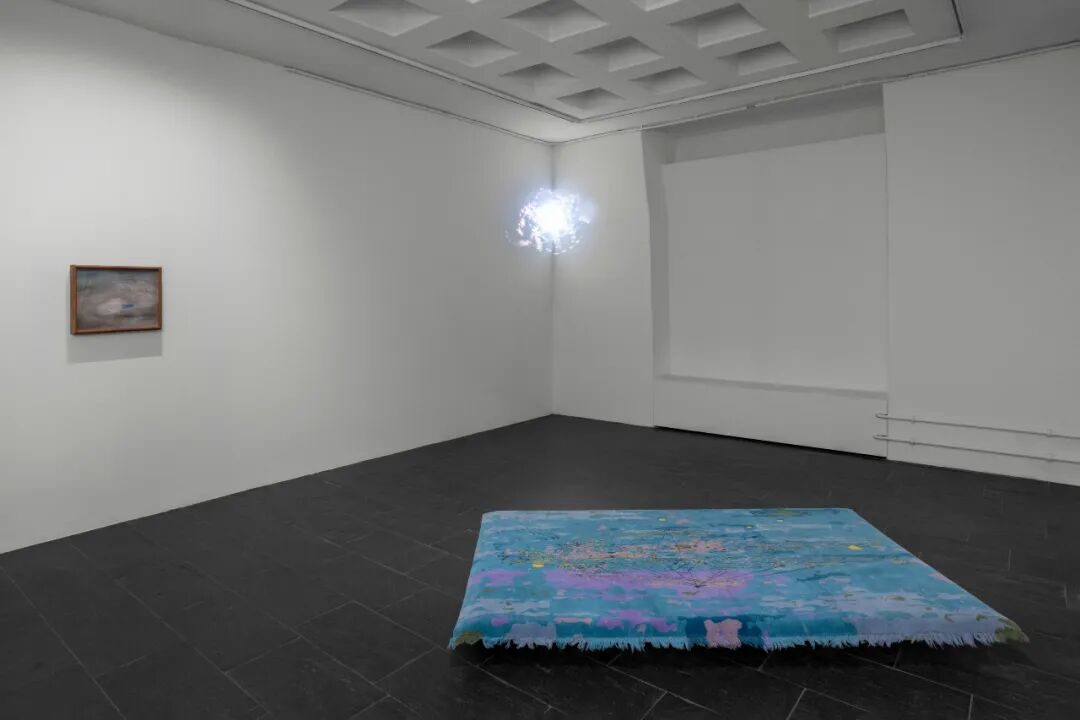
从一楼往下至底层夹层,观者便沉浸在一个触觉记忆与仪式感交汇的空间。展厅中央陈列着《cosmos no. 1》,这件在尼泊尔精心手工织就的地毯被放置于展台上,邀请观者环绕观看。这件作品诞生于雷娜与牛津大学临床研究单位在加德满都的合作项目,融合了两方科学观察、传统疗愈与精神实践。地毯上纤细的人形线条令人联想到裹尸的仪式,其图案是艺术家与苏利亚地毯工坊当地织工共同构思、采用手工染制的天然羊毛织造。当人们驻足于这件作品前,其富有肌理的表面将观者带入记忆的经纬、循环的能量流动,以及永无止境的生死轮回之中。

cosmos no. 1, 2021, 2/3
200结手织羊毛地毯|200-knot handwoven wool carpet
203 × 126.5 cm
3 版 + 2 AP|edition of 3 + 2 AP
环绕这件作品,投影仪低声嗡鸣着播放昆虫扑向光线的催眠影像。这些作品既营造出氤氲氛围,又保持着晦涩质感,呈现出对死亡与新生的复杂理解。低语的声音、朦胧的视觉画面与轻柔的思绪节奏,共同交织成一场独特的体验——邀请观者沉思可见与不可见世界之间那道微妙的界限。
skin in my stomach将我们引入一个直击感官的世界,充满触感、萦绕心头又深具诗意。在这里,艺术家分享着她对内在智慧的领悟,身体体验与外部世界的界限也逐渐模糊。若要更准确地表达,我想引用雷娜自己的文字:
直到如今,我才感觉自己逐渐找到了专属的语言,用以表达周遭世界与身处其中的自我存在。从对我而言始终神秘的身体出发,在深邃的惊叹与不可调和的虚无间游移,在崇高与具体之间穿梭,既能拉远视角观察宏大关联,又能沉溺于琐碎日常,继而将它们在故事与色彩中交织融合。我不再像早年那样受困于“现实主义”,发现魔幻现实主义比任何“客观”描述都更贴近人类处境,因为我们既生活在物理空间,也同样栖息于精神世界。

float, 2025
绢本及无酸纸上墨彩|ink and watercolor painting on silk and archival paper
53 × 38 × 6.5 cm (带框|framed)
skin in my stomach is the first solo presentation of Lêna Bùi at Galerie Urs Meile where a humble yet rigorous selection of work is featured, charting the artist’s exploration of materials, natural forms and the notion of body as an interchangeable reflection of the world, in a variety of media including silk paintings, photography, handwoven tapestry and moving image.
Informed by the body’s internal processes and in ecologist David Abrams’ concept of the body as “the locus of change”, Lêna sees the body as the “direct and only way to experience the world and a place to form or break connections”. In many medicinal traditions, the stomach becomes a potent symbol – the seat of nurturing, intuition, and communication, acting as a nexus bridging us with the external world. The artist also sees the human body as a time vessel, one that constantly connects us to our ancestors and the climate that shaped us throughout our history. The stomach, therefore, is the most vulnerable yet the most resilient organ – registering every little change and regulating the body’s exchanges with the outside world in an efficient and elegant manner.
This complex idea unfolds from the ground to the lower mezzanine floor in distinctive but integral sections. Upon entering the gallery, visitors will encounter a series of silk works in varying scales and presentations – placed against the wall or erected in the middle of space. The fluctuating translucency of each work is due to the artist’s alternate use of materials – from silk layered on silk, to silk on printed photography and silk on paper. Fragile, retentive and hard to control! Silk, in general, “breathes” through its thread, reacting to its immediate environment, consequentially requiring patience, skills as well as adaptability.
Lêna’s keen eye often captures fragments of nature – close-up of plants, and intricate life forms – that fascinate her and serve as silent sources of inspiration. These organic details, documented through photographic means, seamlessly find their way into her work, woven through meticulous brushstrokes. She employs wet-silk painting, a technique rooted in Vietnamese artistry, where pigments are layered onto a damp surface, allowing watercolor and ink to flow, blend, and develop gradually. This method lends her images a luminous, ethereal quality, reflecting the translucence of air, humidity, and fleeting moments of life.
Working with silk is an exploration of layered secrets: bright colours can obscure or highlight underlying layers, while darker tones allow glimpses through, creating optical reversals that mirror the complexities of perception. In this, her process echoes the poetic dance of photographic exposure, an act of revealing and concealing, capturing a layered depth of field that invites reflection on the transient, elusive nature of life itself.
Lêna’s choice of materials – whether coincidental or deliberate – allows her formal articulation to be in synergy with her subject of interest. Her combination of photographic imagery with her painterly depiction on silk further amplifies this harmony as both mediums hold within themselves their own compelling articulation of time. Together, the paintings form an acute landscape where internal structures are reimagined as intimate, vulnerable and rhythmic, oscillating between concrete imagery and abstract painterly gestures.
Descending from the ground floor to the lower mezzanine, visitors are immersed in a space where tactile memory and ritual converge. In the middle of the space lies cosmos no. 1, a carpet meticulously handwoven in Nepal, resting on a raised platform, inviting viewers to walk around. Crafted during Lêna’s project with the Oxford University Clinical Research Unit Nepal in Kathmandu, it merges observations of Western science, traditional healing, and spiritual practices. The fine lines of the human figure evoke the ritual of shrouding, woven from designs conceived in collaboration with local weavers of the Surya Rug House, using hand-dyed natural wool. As one spends time with the carpet, its textured surface ground the viewer in a fabric of memory, circular energy flow as well as the endless cycle of life and death.
Surrounding this work, a video projection hums with a hypnotic movement of insects heading towards bright light. Atmospheric and opaque – the works render a complex understanding of mortality and renewal. The murmuring voices, the obscure visuals, and the gentle rhythm of thought weave together into experience – an invitation to contemplate the delicate passage between the seen and unseen.
skin in my stomach invites us into a visceral landscape – tactile, haunting, and deeply poetic – where the artist shares her embrace of the intelligence residing within, and where the boundaries between bodily experience and the world blur. For better words, I would like to recite Lêna’s own writing:
It’s only now, I feel I’m edging closer to a language of my own to express the world around me and my being in it.
Thus, expanding from this body, which is truly mysterious to me, I can somehow feel I’ve arrived at some form of freedom – to oscillate between a deep sense of wonder and an irreconcilable void, to move between the sublime and the concrete, to zoom out and observe the big connections, while being occupied with the banal, and then to mix them up in stories and in colors.
I no longer feel bound by “realism” as in my earlier years, finding that magical realism captures the human condition much closer than any “objective” descriptions for we live as much in our minds as in a physical space.
Exhibition view


雷娜·裴1985年生于越南岘港;目前生活和工作于越南胡志明市。于2007年在美国卫斯理大学获得东亚研究学士学位,并在日本同志社大学学习一年。她的作品阐释了快速发展对于人与自然及其周边环境关系的影响,反思了生活中形而上的部分——信仰、死亡和梦想——对行为和感知的作用。她近年来的作品对现代生活的碎片化以及某种程度的虚无感予以了回应,并试图创作出表达非完全以人类为中心的世界观的作品。她的主要创作媒介涵盖绘画和视频,但也对一切她认为适合作品的媒介保持开放态度。
她的作品曾在众多个展、群展和放映项目中展出,包括曼谷双年展,泰国曼谷(2024);阮氏基金会,越南胡志明市(2024);德尔菲娜基金会,英国伦敦(2023);AFA Monograph,新加坡(2023);济州岛双年展,韩国(2022);沙迦艺术基金会,阿联酋(2018);Sàn Art,越南(2012);The Factory当代艺术中心,越南(2016)、世界文化之家,德国柏林(2017)以及韦尔科姆收藏馆,英国伦敦(2013)等。
Her work has been shown in solo, group exhibitions and screening programmes such as Bangkok Art Biennale, Bangkok, Thailand (2024); Nguyen Art Foundation, Ho Chi Minh City, Vietnam (2024); Delfina Foundation, London, UK (2023); Asian Film Archive Monograph, Singapore (2023); 2022 Jeju Biennale, the Asia Culture Center, South Korea (2022); Sharjah Art Foundation, UAE (2018); Sàn Art, Saigon, Vietnam (2012); The Factory Contemporary Art Center, Saigon, Vietnam (2016); Haus der Kulturen der Welt, Berlin, Germany (2017); and the Wellcome Collection, London, UK (2013).


